After failing high school - disillusioned with the meaning of life - David drifted until he was introduced to the Metaphysics of Quality. He now spends his time living the philosophy and hopefully demonstrating to others its greatness!

"Metaphysics is good if it improves everyday life; otherwise forget it."
Robert Pirsig
After failing high school - disillusioned with the meaning of life - David drifted until he was introduced to the Metaphysics of Quality. He now spends his time living the philosophy and hopefully demonstrating to others its greatness!
‘Money, in the MOQ, is a pure and simple index of social quality.’
Robert Pirsig
With money representing social quality, the direct link between a government’s budget and what it considers as valuable becomes immediately apparent. Looking at the budgets of the US, UK and Australia is therefore a great way to see what each culture deems valuable.

A lot can be said about a culture by what it spends its money on. In fact it could be said that a culture is what it spends its money on, because a culture is what it values. I won’t get into the details of each budget and the morality of each according to the MOQ in this post but first I just want to spend some time discussing the limits of a budget, what they’re thought to be, and what they actually are.
Basically, current economic thinking claims that budgets are constrained by their deficit. A government’s budget is compared to a household budget and deficits are seen as some kind of a sin to be avoided and surpluses are seen as a good to be continued. However the problem with this thinking is that a government’s budget is not constrained as per a household due to the fact that a government, unlike a household, can produce its own money without constraint. How then, did we end up with this discrepancy?
Historically, the value of money had been pegged against the gold standard, and as there was a limited supply of gold, there was indeed a limit to how much money could be spent relative to the amount of gold available. However in 1971 President Nixon ended international convertibility of the U.S. Dollar to gold and floated the currency. Since then, standard economic thinking doesn’t appear to have adapted to the fact that there is no longer such a restriction in the amount of money a government can produce!
That’s not to say there aren’t constraints however. Simply speaking, the true constraint to an economy is inflation when ‘too much money chases too few goods’. This isn’t a risk though, when the output(goods) of an economy isn’t at a maximum as would be the case when there is unemployment. Because of this, a government backed Job Guarantee, would be not only obviously good for the individuals unemployed, but a great way to keep an otherwise unemployed workforce, skilled and available for the private sector when required.
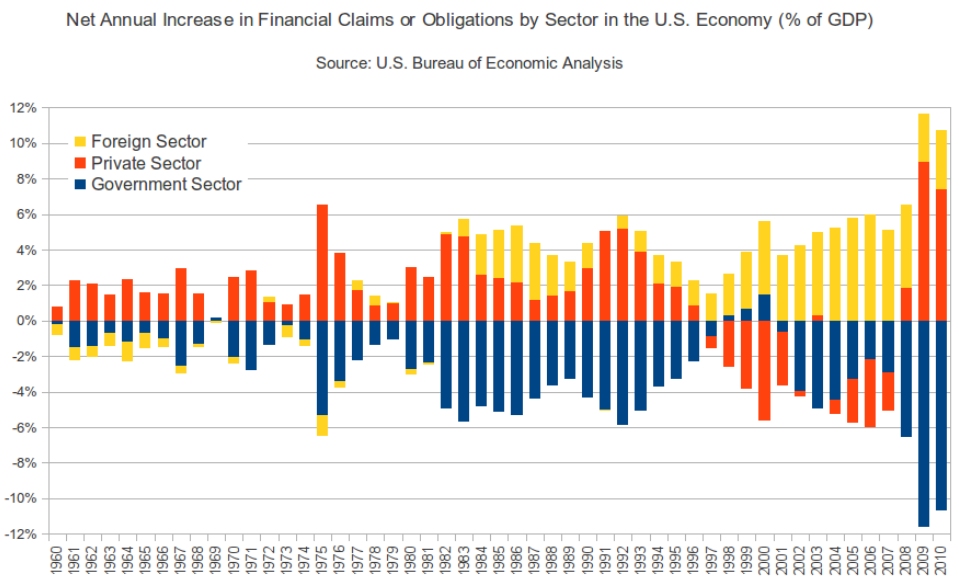
And this is the argument of Modern Monetary Theory(MMT), which supports not only a Job Guarantee but also government deficits. Deficits are seen as typical because the private sector, which would then be in surplus(graph above), values saving money for harder times. Such economic thinking, resulting in a great increase in the quality a society can produce, is strongly supported by the Metaphysics of Quality and why I’ve written about it here. MMT is becoming increasingly popular as an alternative to the austerity being applied to many struggling economies around the world.


The New Age movement and the MOQ on first glance are well suited for one another. As Wikipedia says:
‘The movement aims to create “a spirituality without borders or confining dogmas” that is inclusive and pluralistic. It holds to “a holistic worldview,” emphasizing that the Mind, Body, and Spirit are interrelated.’
However the problem begins with the addition of the term ‘spirit’. It’s a slippery word which can lead to folks getting burned at the stake because of their bad ‘spirits’. Once ‘spirit’ is brought into the conversation you can say goodbye to the empirically verifiable strength of science and hello to pseudoscience and anyone bringing in whatever pseudo-scientific thing they see fit.
The term value on the other hand cannot be co-opted in such a way. Anything can be valuable but using the MOQ we can break value up into a hierarchy of values, each level of which are part of experience and can be empirically verified.
There is an advantage to the New Age movement however and that’s in its ability to create a space where science, and specifically quantum mechanics, can be discussed in an easily accessible way way that won’t shy away from any apparent logical inconsistencies.
In a popular New Age movie called ‘What the bleep do we know?’ there is a great explanation (above) of the famous double slit experiment. The explanation ends with the statement “The observer collapsed the wave function simply by observing!” and from a value free objective scientist perspective that would be the correct way of putting it. However a better way to put it is that the “values of the observer dictated what was observed” because , unlike a scientist may assume, values are more fundamental than physical matter.
Jeni Cross who is a sociology professor at Colorado State University, talks about the three Myths of Behavior change. In these notes below I’ve ignored the SOM jargon and instead written about how the research applies to values. I could find five main takeaways from the 3 Myths.
MYTH 1. Information is enough to change behavior.
If we speak to what folks value by making things tangible, personalized and interactive this is far more likely to change their mind than simply supplying them facts.
Also, because folks are also loss averse, that is, they don’t want to lose value they already have, they are far more likely to change their behavior if it means they won’t lose value.
MYTH 2. Changing attitudes changes behavior.
You can actually set qualitative behavioral expectations to change behavior and attitudes.
You can also change behavior by speaking to what folks already value.
MYTH 3. Folks know their values.
– In the morning before dressing, light incense and meditate.
– Retire at a regular hour. Partake of food at regular intervals. Eat with moderation and never to the point of satisfaction.
– Receive a guest with the same attitude you have when alone. When alone, maintain the same attitude you have in receiving guests.
– Watch what you say, and whatever you say, practice it.
– When an opportunity comes do not let it pass by, yet always think twice before acting.
– Do not regret the past. Look to the future.
– Have the fearless attitude of a hero and the loving heart of a child.
– Upon retiring, sleep as if you had entered your last sleep. Upon awakening, leave your bed behind you instantly as if you had cast away a pair of old shoes.
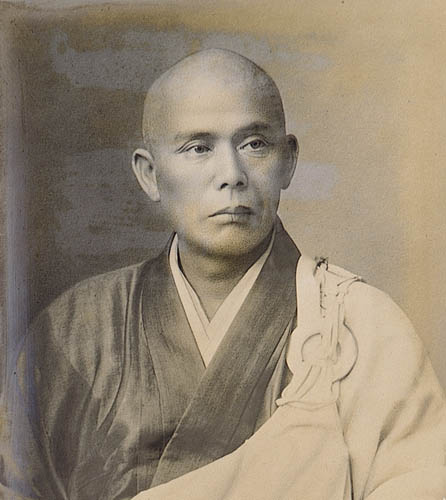
Soyen Shaku