

The Metaphysics Of Quality supports Bernie Sanders
Politics

With polls showing Hillary Clinton as the likely Democratic nominee it is important to note at this point in history that Bernie Sanders is the candidate most supported by the Metaphysics Of Quality.

Compared to his opponents Bernie has consistently stood on the side of what made sense intellectually despite what was culturally expedient. While intellectual stubbornness is not always a clear sign of intellectual correctness, since he was a young academic protesting against the civil rights movement, Bernie has continually been on the right side of history.

This consistency is perfectly demonstrated in his rhetoric around income inequality. As he said in the 1970’s:

“A handful of people own almost everything … and almost everybody owns nothing. A handful of people make the decisions and the vast majority of people have virtually no control over their lives.. The rich are getting richer and the poor are getting poorer, and the vast majority in the middle are having a harder and harder time,”

And on his 2016 campaign website:

“America now has more wealth and income inequality than any major developed country on earth, and the gap between the very rich and everyone else is wider than at any time since the 1920s.. There is something profoundly wrong when the top one-tenth of one percent owns almost as much wealth as the bottom 90 percent.”

The time is right for the United States to make some difficult, drastic, changes with so many problems facing the nation in this new century. Rightly, or wrongly, the way that change works in western democracies is a revolution of freedom against old rituals – and boy are some of the problems facing the United States old. Problems which include a crumbling infrastructure, student debt that’s skyrocketing, bad money influencing elections, a failed war on drugs, unsustainable wages, changing demographics, race inequality, expensive healthcare, and an unstable middle east.

Bernie has consistently spoken about each of these issues and how he will fix them. His logical consistency and correctness is supported by intellectual morality. Many of his new policies are dramatic enough that they would drastically change the country toward a better direction.

The right thing to do then, metaphysically, is to support Bernie in his 2016 campaign to become president.

TOPICS:
The Morality of Money
Politics

‘Money, in the MOQ, is a pure and simple index of social quality.’
Robert Pirsig

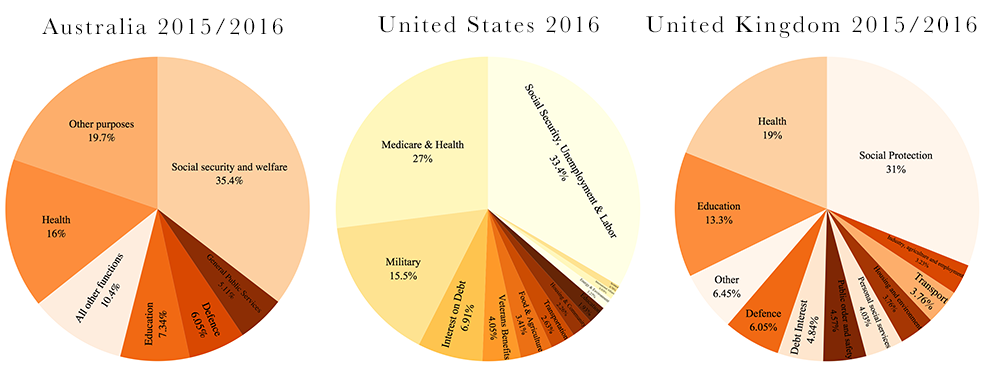
With money representing social quality, the direct link between a government’s budget and what it considers as valuable becomes immediately apparent. Looking at the budgets of the US, UK and Australia is therefore a great way to see what each culture deems valuable.

Budgets

A lot can be said about a culture by what it spends its money on. In fact it could be said that a culture is what it spends its money on, because a culture is what it values. I won’t get into the details of each budget and the morality of each according to the MOQ in this post but first I just want to spend some time discussing the limits of a budget, what they’re thought to be, and what they actually are.

Basically, current economic thinking claims that budgets are constrained by their deficit. A government’s budget is compared to a household budget and deficits are seen as some kind of a sin to be avoided and surpluses are seen as a good to be continued. However the problem with this thinking is that a government’s budget is not constrained as per a household due to the fact that a government, unlike a household, can produce its own money without constraint. How then, did we end up with this discrepancy?

Historically, the value of money had been pegged against the gold standard, and as there was a limited supply of gold, there was indeed a limit to how much money could be spent relative to the amount of gold available. However in 1971 President Nixon ended international convertibility of the U.S. Dollar to gold and floated the currency. Since then, standard economic thinking doesn’t appear to have adapted to the fact that there is no longer such a restriction in the amount of money a government can produce!

That’s not to say there aren’t constraints however. Simply speaking, the true constraint to an economy is inflation when ‘too much money chases too few goods’. This isn’t a risk though, when the output(goods) of an economy isn’t at a maximum as would be the case when there is unemployment. Because of this, a government backed Job Guarantee, would be not only obviously good for the individuals unemployed, but a great way to keep an otherwise unemployed workforce, skilled and available for the private sector when required.

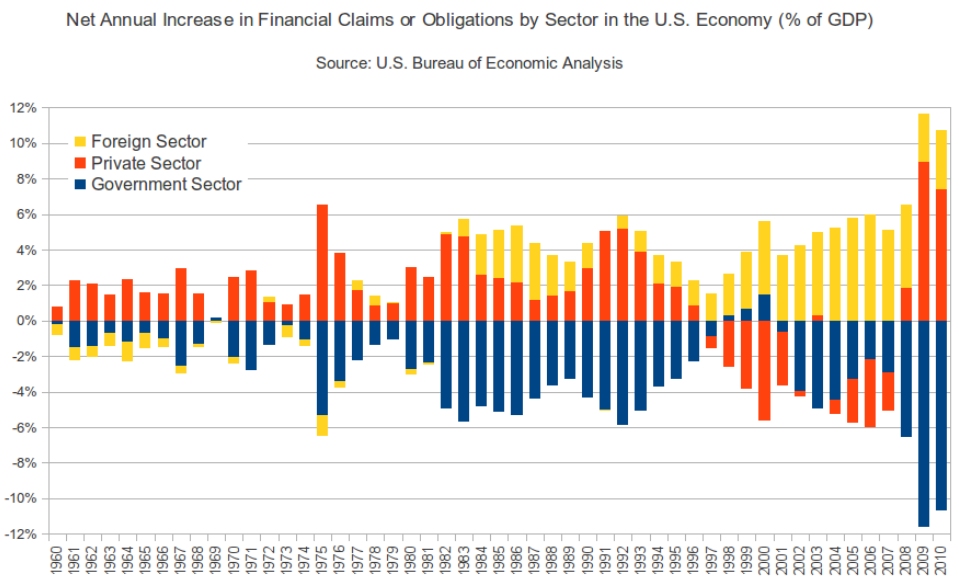
And this is the argument of Modern Monetary Theory(MMT), which supports not only a Job Guarantee but also government deficits. Deficits are seen as typical because the private sector, which would then be in surplus(graph above), values saving money for harder times. Such economic thinking, resulting in a great increase in the quality a society can produce, is strongly supported by the Metaphysics of Quality and why I’ve written about it here. MMT is becoming increasingly popular as an alternative to the austerity being applied to many struggling economies around the world.

Major proponents of MMT are Stephanie Kelton who is presidential candidate Bernie Sanders chief economic advisor, as well as fellow Australian Bill Mitchell who coined the term ‘Modern Monetary Theory’ and who is currently pushing the UK Labour opposition party (under Jeremy Corbyn) to give MMT a go. You can follow them on Twitter via [@stephaniekelton](https://twitter.com/stephaniekelton) and [@billmitchell](https://twitter.com/billy_blog).
TOPICS:
Glenn Greenwald on Journalism and Values
culture

Glenn Greenwald is a great journalist. Why? Because his view of journalism; that it’s firstly meant to act as a check to power, is a good one. Without journalists informing the public about what their elected officials are doing; there are closed doors and an environment which is conductive to abuse. The role of journalism as the fourth estate is that it tempers that power by making actions made in its name public and thus open to being held to account.

But it’s not just his view of journalism as a check on power which is good. He also understands, in line with the Metaphysics of Quality, that it’s impossible for anyone to hold an objective, value free viewpoint. As Pirsig writes in Zen and the Art of Motorcycle Maintenance:

“The difference between a good mechanic and a bad one, like the difference between a good mathematician and a bad one, is precisely this ability to select the good facts from the bad ones on the basis of quality. He has to care! This is an ability about which formal traditional scientific method has nothing to say. It’s long past time to take a closer look at this qualitative preselection of facts which has seemed so scrupulously ignored by those who make so much of these facts after they are ‘observed.'”

In fact, Glenn articulates that it’s this value free viewpoint that modern day journalists cling to as a defense whenever they saddle up next to those in power and stenographically transcribe what they say. They claim that they’re being ‘objective’ but really they’re just transcribing what the powerful wants us to hear rather than doing their job and looking out for those things which are valuable for the public to know regardless of what those in power say.

Along these lines, recently Greenwald had a fascinating exchange with the New York Times Bill Keller in which he summarised his view on modern journalism and the role of the NYT thus:

“My view of journalism absolutely requires both fairness and rigorous adherence to facts. But I think those values are promoted by being honest about one’s perspectives and subjective assumptions rather than donning a voice-of-god, view-from-nowhere tone that falsely implies that journalists reside above the normal viewpoints and faction-loyalties that plague the non-journalist and the dreaded “activist.”

Embedded in The New York Times’s institutional perspective and reporting methodologies are all sorts of quite debatable and subjective political and cultural assumptions about the world. And with some noble exceptions, The Times, by design or otherwise, has long served the interests of the same set of elite and powerful factions. Its reporting is no less “activist,” subjective or opinion-driven than the new media voices it sometimes condescendingly scorns.”

The discussion is centred around the new media venture of which Greenwald is starting with Pierre Omidyar. It should be interesting to see what form it takes. But I recommend the whole exchange as it’s a great intellectual discussion between a prominent modern day journalist in that of Keller and one of the more adversarial journalists of our times in Greenwald.

TOPICS:
Politics

“Lying just beneath the surface of (political) arguments with passions raging on all sides are big questions of Moral Philosophy.. But we too rarely articulate and defend and argue about those big moral questions in our Politics”
Michael Sandel

Michael Sandel has a great series on Justice which explains the currently competing philosophical theories of social justice that exist in the world today. Unlike anyone else I’ve seen he’s bringing the problems of Moral Philosophy to the public at large in an easily accessible way.

In the TED Talk above, Sandel gives a passionate plea to bring some of this intelligent philosophical discourse to our political dialogue. I share his frustration and it is heartwarming to see someone make such an argument in a public setting. Of course, the Metaphysics of Quality provides us with a vastly improved language with which we can discuss morality and it brings with it coherence and evolutionary context to these discussions where there previously was none.

TOPICS: